
Innovation and research are increasingly at the core of the development strategies of companies, public bodies and organizations. In this context, research funding represents an important tool for transforming innovative ideas into concrete projects and fostering the development of new technologies, methodologies and services.
Funded research encompasses all research and development activities supported through public funding provided by regional, national or European programmes. Technology transfer, on the other hand, is the process through which knowledge, expertise and research outcomes are transformed into solutions that can be applied by businesses, public administrations and other end users.
Research funding instruments, including numerous programmes and funding opportunities for innovative SMEs, provide an important opportunity to develop new technologies, test innovative approaches and accelerate their practical implementation. However, obtaining funding is not an end point but rather the beginning of a process that requires project management skills, research and development activities, validation of results and assessments of their long-term applicability.
Organizations such as PM_TEN, established as a university spin-off and now operating as an innovative SME, work precisely at the intersection of research and application, helping to transform scientific knowledge into methodologies, tools and services that support environmental monitoring.
In this article, we will explore how a concrete need can evolve into a research project, how to identify the most suitable funding opportunities, what stages lead to the development and validation of an innovative solution, and which aspects should be considered to ensure that the results continue to generate value even after the project has concluded.
From market needs to a research project
Contrary to what one might think, the availability of a funding call should not be the starting point of a research project. Innovation generally begins with the identification of a concrete problem or an unmet need.
This may involve, for example, the need to monitor an environmental phenomenon more accurately, assess the impacts of human activities, improve the efficiency of a process, or develop new decision-support tools. Once the need has been identified, the company can transform it into a structured project idea and subsequently assess whether suitable funding opportunities are available. In this context, applied research represents the step that transforms an operational need into a pathway for innovation and development.
Research and innovation funding programmes generally make use of the categories defined by European State aid regulations:
- fundamental research, aimed at acquiring new knowledge;
- industrial research, aimed at developing knowledge that can be used to create new products, processes or services;
- experimental development, focused on the creation and validation of prototypes, demonstrators and pilot projects.
The role of technology transfer and university spin-offs
Within this process, technology transfer plays a central role by enabling scientific results and specialized knowledge to be transformed into practical applications. University spin-offs can also make an important contribution, as they are specifically created to bridge the gap between academia and the market.
This is precisely the case of PM_TEN , founded in 2012 as a spin-off of the Environmental Physics Laboratory of the University of Genoa. Today, the company is an innovative SME whose mission is to transfer expertise and methodologies developed in academia into practical applications for environmental monitoring, atmospheric modelling and air quality assessment.
What is an innovative SME?
An innovative SME is a specific category of enterprise introduced by Italian Legislative Decree 3/2015 to support organizations characterized by a strong focus on technological innovation and research. This status is granted to companies that meet specific legal requirements and whose eligibility can be verified through official documentation provided by the Italian Ministry of Enterprises and Made in Italy (MIMIT).
Funding opportunities for research and innovation in SMEs
European Union funding supports initiatives that contribute to strategic objectives such as research, innovation, climate action, education and social inclusion. Access to these resources generally takes place through public calls for proposals, to which companies, organizations and public bodies may submit project applications. Successful projects receive financial support to implement the proposed activities. Research support opportunities also include innovation grants, alongside other financing instruments aimed at strengthening companies’ technological development and competitiveness.
Research funding opportunities are available at several levels:
- regional level: programmes such as European Regional Development Fund (ERDF) support investments in innovation, digitalization and technological development;
- national level: funding instruments promoted by ministries, public agencies and research organizations are available;
- European level: programmes such as Horizon Europe fund European collaborative research projects and the development of innovative technologies; LIFE supports environmental and climate-action initiatives; and Interreg promotes cooperation among regions from different Member States through cross-border, transnational and interregional projects.
Each funding call has specific characteristics in terms of eligible beneficiaries, eligible activities, funding rates, evaluation criteria and deadlines. For this reason, it is always essential to consult the most up-to-date official documentation before preparing a project proposal.
Cascade funding and open calls: what are they?
In recent years, so-called cascade funding schemes, also known as open calls, have become increasingly important.
Under this model, resources are not allocated directly to companies but to a lead organization, such as an innovation ecosystem, an extended partnership or a consortium. This entity then publishes dedicated calls aimed at companies, startups and research organizations.
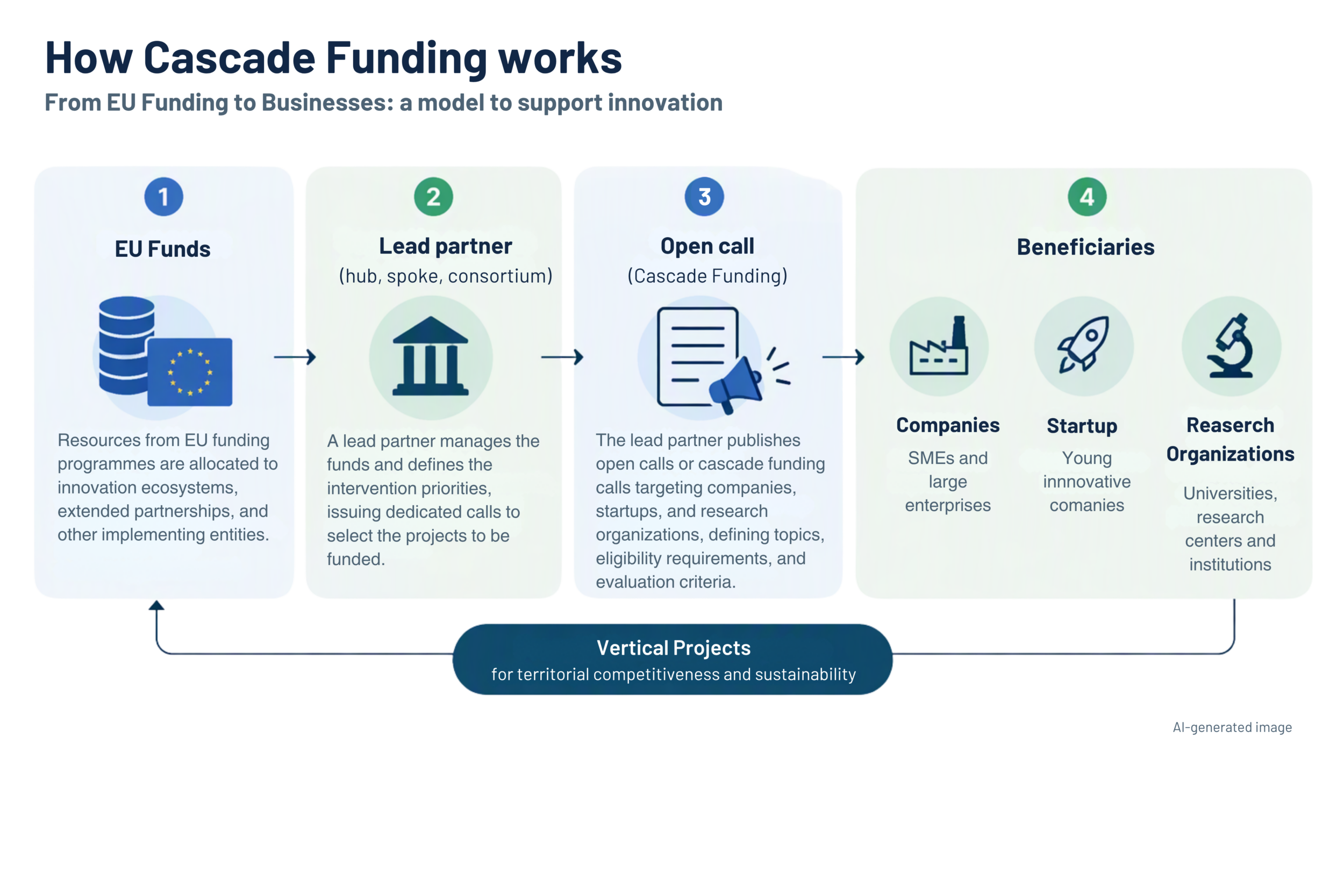
Many of the most significant cascade funding initiatives launched in recent years have been linked to Italy’s National Recovery and Resilience Plan (PNRR) and innovation ecosystems. These initiatives are now approaching completion as they are tied to the PNRR implementation timeline ending in 2026. Their objective has been to accelerate technology transfer and promote the practical application of research results.
Examples include the EMC4Ports and MESSAPI projects, developed within the RAISE innovation ecosystem and funded through cascade funding schemes dedicated to industrial research and experimental development in the fields of artificial intelligence, robotics and environmental monitoring.
Within the EMC4Ports project, PM_TEN contributes to the development of Lagrangian models for pollutant dispersion simulation, integrated with smart sensors and IoT technologies for monitoring environmental conditions in port areas. Within the MESSAPI project, the company provides expertise in environmental modelling and in the analysis of data collected through drones and robotic systems, with the aim of developing innovative solutions for territorial monitoring and decision support.
How to evaluate a funding call before submitting a project
The evaluation of a funding opportunity should begin by assessing the consistency between the objectives of the call and the project that is intended to be developed.
Key aspects to consider include:
- the type of activities eligible for funding;
- beneficiary eligibility requirements;
- the required level of technological maturity;
- eligible costs;
- funding intensity;
- the maximum project duration;
- any partnership requirements;
- expected results and impact indicators.
Even a well-designed project may fail to pass the evaluation stage if it is not aligned with the objectives of the funding call.
From a funding call to a research and development project
Once the most suitable opportunity has been identified, the idea must be transformed into a structured project.
This process requires defining the problem to be addressed, measurable objectives, the planned research and development activities, expected outcomes, timelines and the resources required. In particular, objectives should be formulated in a clear and verifiable manner, enabling an objective assessment of the results achieved at the end of the project. It is also essential to define a budget that is consistent with the planned activities, identifying the financial, human and technological resources needed to carry out the different project phases effectively. Careful planning is equally important for the reporting requirements of European and national projects, which require the proper traceability of expenditures, activities performed and results achieved.
Stakeholders and partnerships: who should be involved in a project?
Another often decisive aspect concerns the involvement of stakeholders, namely the individuals or organizations that may be interested in or affected by the project’s outcomes. Involving public authorities, companies, infrastructure operators, local communities and potential end users from the earliest stages makes it possible to gather concrete needs, better orient research activities and increase the likelihood that the results will find practical application once the project has been completed.
Added value often stems from the creation of partnerships that bring together complementary expertise. Universities, research centres, innovative SMEs and technology partners can contribute different specialist skills, increasing the likelihood of project success and facilitating subsequent technology transfer.engaging and accessible learning opportunities.
From research to a service: prototypes, validation and TRLs
The path that leads from research to the development of new, usable services generally progresses through a series of phases.
It begins with analysing user needs and defining the solution to be developed, activities that are essential to ensure the research addresses real-world challenges. These are followed by experimental development activities, during which proofs of concept and prototypes are created to verify the technical feasibility of the idea and identify potential issues before large-scale deployment.
Once an initial version of the solution has been developed, testing and pilot activities are carried out, often within pilot environments identified during the project design phase. This stage is particularly important because it allows the performance of the solution to be assessed in operational scenarios, useful data to be collected, and the effectiveness of the adopted approaches to be verified. At the same time, stakeholder involvement helps gather valuable feedback, identify needs that may not have emerged during the initial phases, and guide subsequent developments.
Technical validation and market validation: understanding the difference
The outcomes achieved are then subject to validation and continuous improvement processes. In this context, it is useful to distinguish between technical validation and market validation.
Technical validation involves verifying that the solution functions correctly, is reliable and achieves the objectives for which it was developed. Market validation, on the other hand, seeks to determine whether users perceive value in the service and whether the delivery model is economically and organizationally sustainable.
What are TRL levels and why do they matter in funding calls?
To assess the progression of development activities, from the initial concept phase through to market deployment, the Technology Readiness Level (TRL) scale has been widely adopted. It measures the maturity of a technology and how close it is to operational application.
| TRL | Description |
|---|---|
| 1-2 | Basic principles observed and concept formulated |
| 3 | Proof of concept |
| 4-5 | Validation in a laboratory or relevant environment |
| 6-7 | Demonstration and prototype in an operational environment |
| 8 | Complete and qualified system |
| 9 | Fully operational technology on the market |
In funded projects, TRL levels play a particularly important role because they help define the starting point and the technological target to be achieved. Many funding calls require applicants to propose solutions with initial and target TRL levels falling within a specific range, using them as an indicator of the expected impact of research and development activities.
When research results become a service
The completion of research activities does not automatically mean that a commercial service is available. Moving from a technical result to an operational service requires clearly defining target users, delivery methods, technological infrastructure, required expertise, implementation timelines, operating costs and support activities.
The outcomes of a project can take various forms, including an innovative methodology, a software platform, a monitoring system, an analytical service or a consultancy solution.
Case study: CALIPSO and carbonaceous aerosol monitoring
One example is the CALIPSO project, which originated from the need to improve the monitoring of carbonaceous aerosols in occupational environments and to develop procedures and operational standards for assessing airborne Elemental Carbon concentrations. Within the project, different sampling and analytical methodologies were compared, while field measurement campaigns and controlled-atmosphere experiments were conducted. The knowledge acquired demonstrates how research can generate methodologies, operational tools and specialist expertise to support environmental monitoring and exposure assessment in workplaces.
Case study: FlashNet, from research to a lightning forecasting service
FlashNet is another example of technology transfer. The technology was developed within the framework of a funded research project (BIVIOS) to address needs identified during the earliest stakeholder engagement activities. It was subsequently integrated into PM_TEN’s forecasting systems to support lightning prediction and risk management.
After funding: results, sustainability and replicability
The completion of a funded project should never coincide with the end of the innovation process. On the contrary, one of the most important challenges is to maximize the value generated through the funded activities and outcomes.
For this reason, it is essential to begin considering the follow-up phase as early as possible. This means planning, while the project is still underway, how the acquired knowledge will be used, who will benefit from the results, and what resources will be needed to maintain, update or expand them over time.
How to measure the success of a funded project
The success of a project does not depend solely on achieving the planned technical objectives. Equally important are factors such as the effectiveness of the developed solutions, the involvement of users during testing activities, the possibility of applying the results in different contexts and the level of interest generated among potential users and stakeholders.
It is also necessary to distinguish research outcomes from their long-term sustainability. A technically successful solution may still require additional investments, further refinement or specific organizational conditions before it can be adopted on a large scale.
Not every research project becomes a service
Finally, it is important to remember that not every research project is intended to become a commercial product or service. In many cases, the value generated lies in the acquisition of new knowledge, the validation of innovative methodologies or the development of expertise that can later be applied and enhanced through future research and innovation activities.
Frequently asked questions
What is the difference between a startup, an innovative SME and a spin-off?
A startup and an innovative SME are legal categories defined by Italian legislation for companies characterized by a strong focus on innovation. A spin-off, on the other hand, is a company established to exploit knowledge, technologies or competencies developed within a university or research institution.
These categories are not mutually exclusive and may coexist, as in the case of PM_TEN, which was founded as an innovative startup and university spin-off of the University of Genoa and has since evolved into an innovative SME.
What does TRL mean in a research project?
TRL stands for Technology Readiness Level and indicates the maturity level of a technology or solution. The scale helps determine how close a technology is to operational deployment or commercialisation.
Does public funding guarantee the success of a new service?
No. Funding enables the development and validation of an innovative solution while reducing investment risk, but success also depends on the project’s technical quality, the existence of a market when the product or service is launched, its economic sustainability and its ability to meet real user needs.